ZenVR: Designing a new interactive meditation activity

ZenVR: Designing a new interactive meditation activity

ZenVR: Designing a new interactive meditation activity

ZenVR is a VR meditation learning platform built around guided mindfulness lessons. After a virtual environment redesign, this project explored how new interactive activities could help users practice mindfulness between lessons.

ZenVR is a VR meditation learning platform built around guided mindfulness lessons. After a virtual environment redesign, this project explored how new interactive activities could help users practice mindfulness between lessons.

Role

Lead Interaction Designer

Outcome

Designed Lantern Calligraphy, an interactive VR meditation activity that helps users practice mindfulness through deliberate movement, personal meaning, and reflection.

01 / Context

What is ZenVR?

What is ZenVR?

What is ZenVR?

ZenVR teaches mindfulness through a structured curriculum of immersive VR lessons. After recently redesigning its virtual environment, the team wanted to introduce new activities that gave users meaningful ways to practice between lessons.

ZenVR teaches mindfulness through a structured curriculum of immersive VR lessons. After recently redesigning its virtual environment, the team wanted to introduce new activities that gave users meaningful ways to practice between lessons.

The redesigned world gave users more room to explore, but simply filling it with content was not enough. Every new experience needed to reinforce the same principles taught throughout ZenVR’s curriculum.

The redesigned world gave users more room to explore, but simply filling it with content was not enough. Every new experience needed to reinforce the same principles taught throughout ZenVR’s curriculum.

That shifted the challenge from designing another VR activity to designing a practice users could return to after a lesson ended.

That shifted the challenge from designing another VR activity to designing a practice users could return to after a lesson ended.

02 / Design Question

Problem statement

Problem statement

Problem statement

ZenVR had just released a new, redesigned virtual world - but there was one problem: it was barren. While there was lots of room to explore, users had nothing to do in the new world - they needed new activities to fill the space and make it more engaging.

ZenVR had just released a new, redesigned virtual world - but there was one problem: it was barren. While there was lots of room to explore, users had nothing to do in the new world - they needed new activities to fill the space and make it more engaging.

How might we create engaging experiences that allow current ZenVR users to explore and connect with alternative meditative practices to better reach their own zen?

How might we create engaging experiences that allow current ZenVR users to explore and connect with alternative meditative practices to better reach their own zen?

How might we create engaging experiences that allow current ZenVR users to explore and connect with alternative meditative practices to better reach their own zen?

The goal was to create an activity was designed for current ZenVR users: people who already understood the lesson structure and needed new ways to keep practicing mindfulness inside the redesigned environment.

The goal was to create an activity was designed for current ZenVR users: people who already understood the lesson structure and needed new ways to keep practicing mindfulness inside the redesigned environment.

This framed the work around curriculum fit, intentional movement, reflection, and low-pressure interaction. The activity needed to feel meaningful, not just novel.

This framed the work around curriculum fit, intentional movement, reflection, and low-pressure interaction. The activity needed to feel meaningful, not just novel.

03 / Understanding the Space

Research insights

Research insights

Research insights

Rather than starting with VR mechanics, we first looked at how people practice mindfulness outside of VR. The most meaningful experiences were not built around completing a task; they were built around intentional movement, repetition, reflection, and presence.

That became the foundation for evaluating every concept. Instead of asking whether an idea would be engaging in VR, we asked whether the interaction would actually help someone practice mindfulness.

From customer feedback, app teardown, and meditation research, we translated mindfulness qualities into interaction principles: repetition, rhythm, intentional movement, low pressure, and reflection. The strongest opportunity was to connect a physical action with reflective meaning.

Diagram showing competitive anlysis performed of mobile & VR-specific mediation apps

What this showed

The strongest competitors created calming environments, but few made the interaction itself feel meditative or necessary in VR. This pushed us toward a concept where movement, interaction, and reflection were built into the core activity instead of added around it.

04 / Concept Exploration

Concept exploration

Concept exploration

Concept exploration

We explored several meditative activities and tested storyboard directions with meditation experts. Instead of judging concepts only by how calming they sounded, we compared whether each one created a meaningful action, used VR in a necessary way, and fit ZenVR’s lesson-based structure.

Click to see storyboard

Candle Breathing

Candle Breathing emphasizes focus and repetition through breathing, but it was too simple and not meaningful enough

Candle Breathing emphasizes focus and repetition through breathing, but it was too simple and not meaningful enough

Candle Breathing emphasizes focus and repetition through breathing, but it was too simple and not meaningful enough

Rock Stacking

Rock Stacking used spatial interaction to stack rocks, but the link to ZenVR’s lessons was less direct.

Rock Stacking used spatial interaction to stack rocks, but the link to ZenVR’s lessons was less direct.

Rock Stacking used spatial interaction to stack rocks, but the link to ZenVR’s lessons was less direct.

Scenic Haiku

Scenic Haiku encouraged reflection and haiku writing, but did not take full advantage of embodied VR interaction.

Scenic Haiku encouraged reflection and haiku writing, but did not take full advantage of embodied VR interaction.

Scenic Haiku encouraged reflection and haiku writing, but did not take full advantage of embodied VR interaction.

Water Garden Building

Water Garden Building encouraged playfulness and reflection, but lacked link to core ZenVR curriculum

Water Garden Building encouraged playfulness and reflection, but lacked link to core ZenVR curriculum

Water Garden Building encouraged playfulness and reflection, but lacked link to core ZenVR curriculum

Lantern Calligraphy

Lantern Calligraphy combined slow gesture, personal meaning, visual feedback, and a reflective ending to create a meaningful lantern.

Lantern Calligraphy combined slow gesture, personal meaning, visual feedback, and a reflective ending to create a meaningful lantern.

Lantern Calligraphy combined slow gesture, personal meaning, visual feedback, and a reflective ending to create a meaningful lantern.

A expert evaluation with meditation experts then helped us separate ideas that were pleasant from ideas that could become a practice. Concepts were strongest when the interaction itself supported mindfulness rather than simply decorating a relaxing scene.

A expert evaluation with meditation experts then helped us separate ideas that were pleasant from ideas that could become a practice. Concepts were strongest when the interaction itself supported mindfulness rather than simply decorating a relaxing scene.

Diagram showing expert evaluation performed with mediation experts

Expert feedback summary

Meditation experts responded most strongly to Lantern Calligraphy because each step had a meditative purpose: setting an intention, tracing slowly with focus, and ending with a moment of release.

05 / Concept Comparison

Why Lantern Calligraphy was chosen

Why Lantern Calligraphy was chosen

Why Lantern Calligraphy was chosen

Comparing each activity with experts helped separate concepts that were simply calming from concepts that used VR to support mindful practice. The strongest concepts needed to satisfy four criteria at once: intentional movement, meaningful VR interaction, curriculum fit, and reflection.

Lantern Calligraphy stood out because every step served the same reflective goal: choose an intention, trace it slowly, then release it. The concept made the user’s movement part of the meditation, which made it feel more connected to ZenVR than activities that were mostly scenic or procedural.

Concept

Intentional Movement

VR Interaction

Curriculum Fit

Reflection

Candle Breathing

Rock Stacking

Scenic Haiku

Water Garden Building

Lantern Calligraphy

● Strong fit

◐ Partial fit

This made Lantern Calligraphy feel like a continuation of ZenVR’s teaching model rather than a separate 'mini-game' added onto the product.

Concept

Intentional Movement

VR Interaction

Curriculum Fit

Reflection

Candle Breathing

Rock Stacking

Scenic Haiku

Water Garden Building

Lantern Calligraphy

06 / Why Lantern Calligraphy

Lantern Calligraphy as an activity

Lantern Calligraphy as an activity

Lantern Calligraphy as an activity

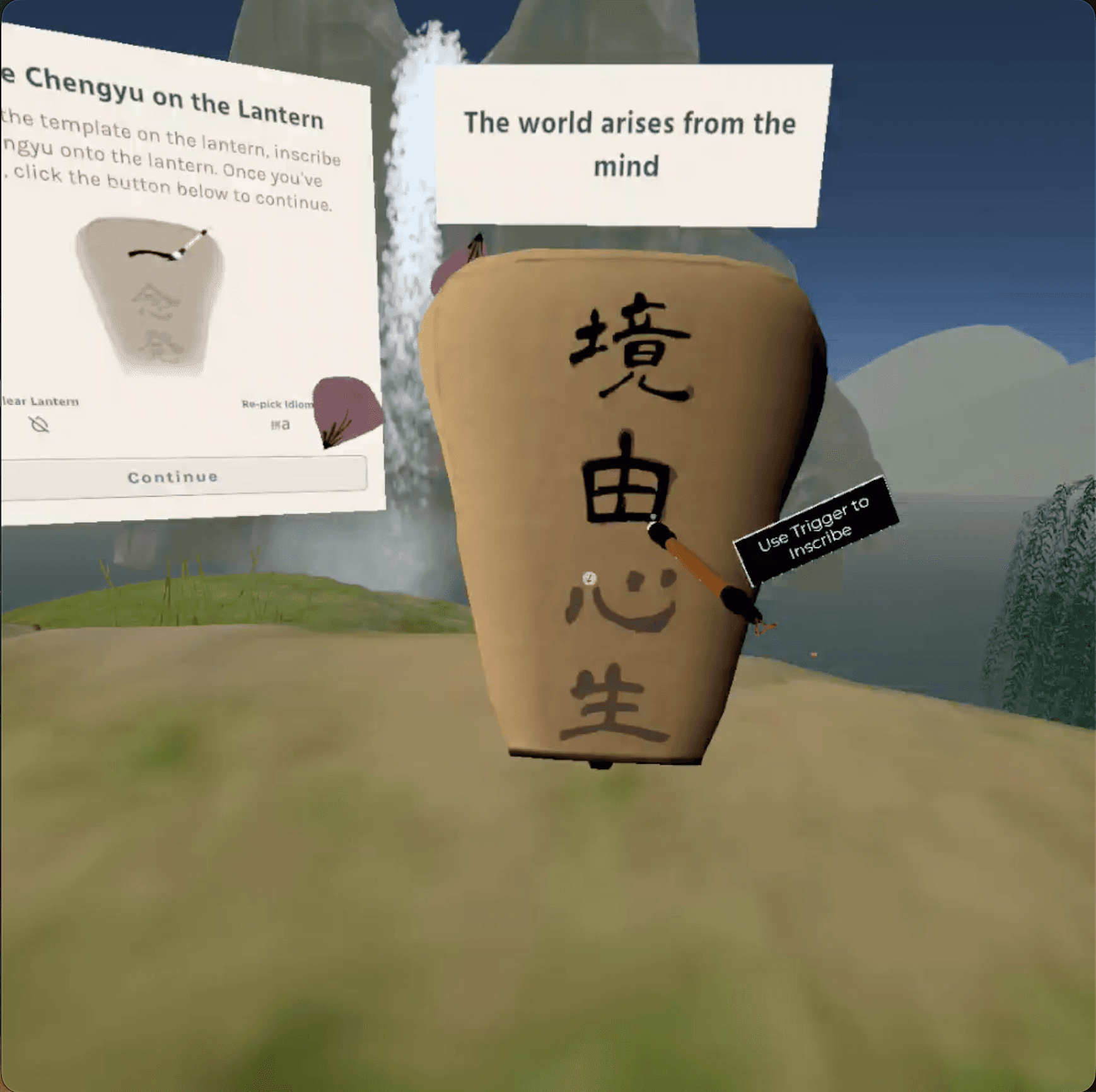
After each core lesson, users choose a short chengyu, or Chinese idiom, connected to that lesson’s theme. They trace it onto a lantern and release it into the virtual environment, turning the lesson into a short reflective practice.

Each step has a specific purpose: choosing a chengyu sets intention, tracing slows the body down, and releasing creates a reflective ending. The activity was designed to enhance ZenVR’s curriculum rather than interrupt it.

That made Lantern Calligraphy useful as a complement to the core lessons, not just a visual moment. The design focused on shaping pace, attention, and emotional tone through interaction.

01

It made mindfulness physical

The tracing interaction made mindfulness physical. Users practiced attention through the movement itself.

The tracing interaction made mindfulness physical. Users practiced attention through the movement itself.

02

It avoided performance pressure

The activity avoided performance pressure. The goal was not perfect calligraphy, but a deliberate, repetitive gesture.

The activity avoided performance pressure. The goal was not perfect calligraphy, but a deliberate, repetitive gesture.

03

It ended with reflection

The lantern release gave the experience an ending that felt reflective rather than transactional.

The lantern release gave the experience an ending that felt reflective rather than transactional.

07 / Experience Flow

Experience flow

Experience flow

Experience flow

The experience follows a simple arc: set an intention, trace with care, then release and reflect.

The experience follows a simple arc: set an intention, trace with care, then release and reflect.

01

Choose an intention

Choosing an intention gives the activity personal meaning before the interaction begins.

Choosing an intention gives the activity personal meaning before the interaction begins.

02

Trace with care

Tracing the phrase encourages focus through slow, controlled movement.

Tracing the phrase encourages focus through slow, controlled movement.

03

Release and reflect

Releasing the lantern closes the activity with reflection rather than completion.

Releasing the lantern closes the activity with reflection rather than completion.

08 / Design Decisions

Design decisions

Design decisions

Design decisions

Early feedback showed that lantern calligraphy was successful as a concept, but phrase-selection and instruction panels could create too much cognitive load. Users needed enough context to understand what they were choosing, but long explanations interrupted the meditative pace before the activity even began.

We simplified the flow by reducing instructional copy and audio descriptions, making prompts more direct, and shifting the emphasis from understanding an idiom perfectly to choosing an intention that felt personally meaningful.

We also avoided scoring or correction-heavy feedback. In VR, feedback can quickly feel physical and judgmental because the user’s body is involved. The point of the activity was deliberate attention, not accuracy or speed.

Avoided & Prioritized

Reducing audio cues and focusing the activity around the core tracing interaction made the final experience shorter, calmer, and more meaningful as a complement to ZenVR’s core lessons.

Avoided

Dense explanations, rigid scoring, and correction patterns that made the activity feel like a task instead of a mindful practice.

Prioritized

Short prompts, slow tracing guidance, forgiving feedback, and a reflective release moment that kept attention on intention rather than accuracy.

09 / Polishing the Experience

Taking the activity from beta to polished

After the core concept was working, the biggest shift was visual and experiential polish. The beta version proved the interaction, but the environment still felt rough and the UI competed with the meditative tone.

Use the slider to compare the early prototype with the polished version. The final activity overhauled the environment to feel more immersive, cleaned up the UI, and reduced extra guidance so the interaction felt calmer and more complete.

Final activity
Original prototype
Original prototype
Final activity

Impact of polish

Beta feedback helped shift the activity from a functional prototype into a more immersive meditative experience. By overhauling the environment, simplifying the UI, and reducing extra cues, Lantern Calligraphy felt smoother, more focused, and more complementary to the core lesson.

10 / Outcome

Outcome

Outcome

Outcome

The final concept extended ZenVR’s curriculum with an activity users could practice, not just watch or listen to. It gave the product a new interaction pattern while staying grounded in the existing lesson structure.

Lantern Calligraphy turned mindfulness into a physical interaction: users practiced attention through the movement of tracing and the reflective act of releasing the lantern.

Lantern Calligraphy turned mindfulness into a physical interaction: users practiced attention through the movement of tracing and the reflective act of releasing the lantern.

The project showed that VR UX is less about adding immersion and more about shaping behavior. Pacing, feedback, instruction, and spatial comfort all affect whether an interaction feels mindful, especially when a 2D prototype has to become a 3D embodied experience.

11 / Reflection

Reflection

Reflection

Reflection

This project changed how I think about pacing in interaction design, especially in VR. A flow can seem clear in a 2D prototype, but feel very different once it becomes a 3D spatial experience that asks users to move, look around, read instructions, and stay present.

This project changed how I think about pacing in interaction design, especially in VR. A flow can seem clear in a 2D prototype, but feel very different once it becomes a 3D spatial experience that asks users to move, look around, read instructions, and stay present.

Designing for VR was difficult because much of the planning happened in 2D, while the real experience depended on space, body movement, depth, and attention. Lantern Calligraphy worked best when the interaction stopped feeling like interface work and became part of the meditation itself.

Designing for VR was difficult because much of the planning happened in 2D, while the real experience depended on space, body movement, depth, and attention. Lantern Calligraphy worked best when the interaction stopped feeling like interface work and became part of the meditation itself.

The most important lesson: VR is not just screens placed in 3D. It requires designing movement, pacing, and spatial feedback in ways that are hard to fully judge until the experience is tested in headset.

The most important lesson: VR is not just screens placed in 3D. It requires designing movement, pacing, and spatial feedback in ways that are hard to fully judge until the experience is tested in headset.

The most important lesson: VR is not just screens placed in 3D. It requires designing movement, pacing, and spatial feedback in ways that are hard to fully judge until the experience is tested in headset.